Seeing Meta’s Instagram and Facebook platforms to allow users in some countries to call for violence against Russians and Russian soldiers in the context of the Ukraine invasion is one of the most dystopian news of the past months. The company has been criticised for fueling hatred and hate speech, even with previous policies.
Meta Platforms will allow Facebook and Instagram users in some countries to call for violence against Russians and Russian soldiers in the context of the Ukraine invasion, according to internal emails seen by Reuters on Thursday, in a temporary change to its hate speech policy.
All of Google’s products have been designed to be easily accessible. That included Google Docs and the work app bundle that was GSuite.
Google Campus (from the TechCrunch Article)
When G Suite became Google Workspace in 2020,as part of a mass reorganisation of the company’s apps for the “future of work”, the company also announced the end of a free edition.
Facebook complains how Apple’s approach to privacy in iOS will have a substantial impact to their revenue. Following their own statement the impact will be as high as $10 billion for the current year. Facebook’s business model is widely perceived as being based on violating privacy.
Apple’s privacy feature disrupts the behind-the-scenes mechanics of many mobile ads, especially those that confirm whether a purchase or download was made.
Line goes up: Let’s talk about the Ape in the room: Web3, Cryptocurrencies and NFTs are the hot shit. You absolutely heard about all of this since last year. At least.
The Problem with NFTs (and also Crypto and Web3)
You probably heard all kinds of things about Web3 and supporting technologies, including the Metaverse. And while most of the headlines you’ll typically see revolve around ridiculous numbers the market generates, criticism in the development rises. Technically, most of the technology is sound. However, consequences show in economy and society.
The dependencies are complex and wrapped in complicated language, mixed up with overly difficult expressions for technology.
To understand the market for digital currencies and non-fungible token, Dan Olson of Folding Ideas explains different concepts in the video “Line goes up”. More than 2 hours long.
00:00:00 Preface 00:01:12 0. In 2008 The Economy Collapsed 00:07:09 1. Bitcoin 00:18:18 2. Ethereum 00:24:34 3. The Machine 00:39:07 4. NFTs Exist To Get You To Buy Crypto 00:57:54 5. The Unbearable Cringe Of Crypto 01:11:46 6. A Self-Organizing High Control Group 01:16:57 7. Crypto Reality 01:25:36 8. There Is No Privacy On The Chain 01:32:52 9. If This “Looks Like Scam” Then Every NFT Room I’m In Looks Like Scam LOL 01:38:29 10. Play To Earn Exists To Get You To Buy Crypto 01:46:39 11. We’re All Gonna Make It And By “We” I Mean “Us” Not You 01:56:08 12. DAOs Exist To Get You To Buy Crypto 02:13:21 13. I Know It’s Rigged, But It’s The Only Game In Town
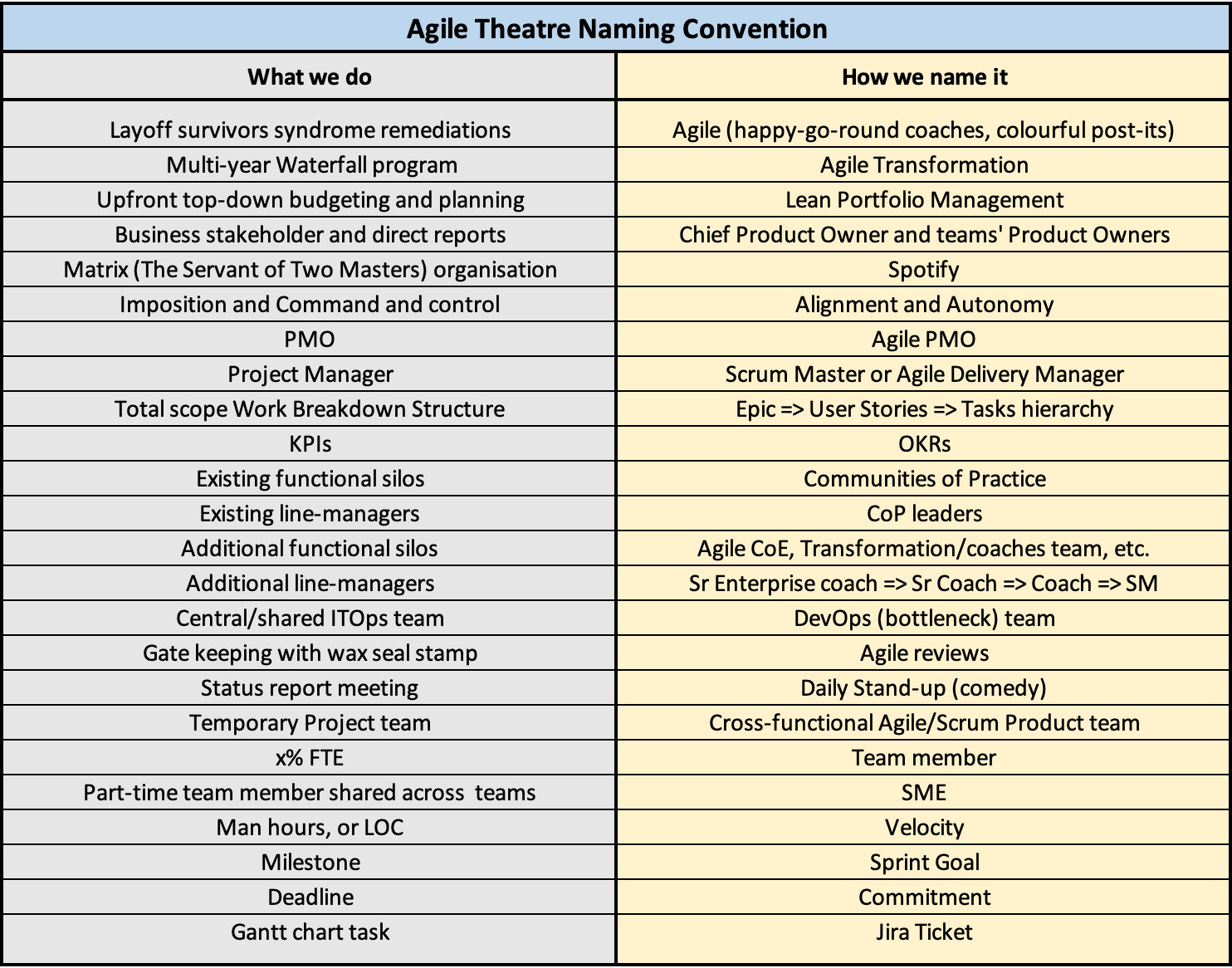
Did you ever work in waterfall managed projects? Coming to a company that introduced agile just recently, chances are you will recognise plenty of behavioural patterns. Playing the waterfall game to pretend to be agile is called an agile theatre.
The phenomenon of this agile theater is not new. And in fact, a misunderstanding of fundamental principles in agile is one of the major issues with the introduction of this approach. Going full agile requires a fundamental change of culture, a lot of trust and self-sufficiency, that most companies cannot find easily, in particular coming from traditional industry best practices and established waterfall procedures. Most often the introduction of agile methods for project- and product management ends with the introduction of new language.
In this matter, smharter.com was kind enough to collect and publish a collection of translation helpers, to help you identify an agile theatre. The terms and their translations will help you identify agile theater much quicker.
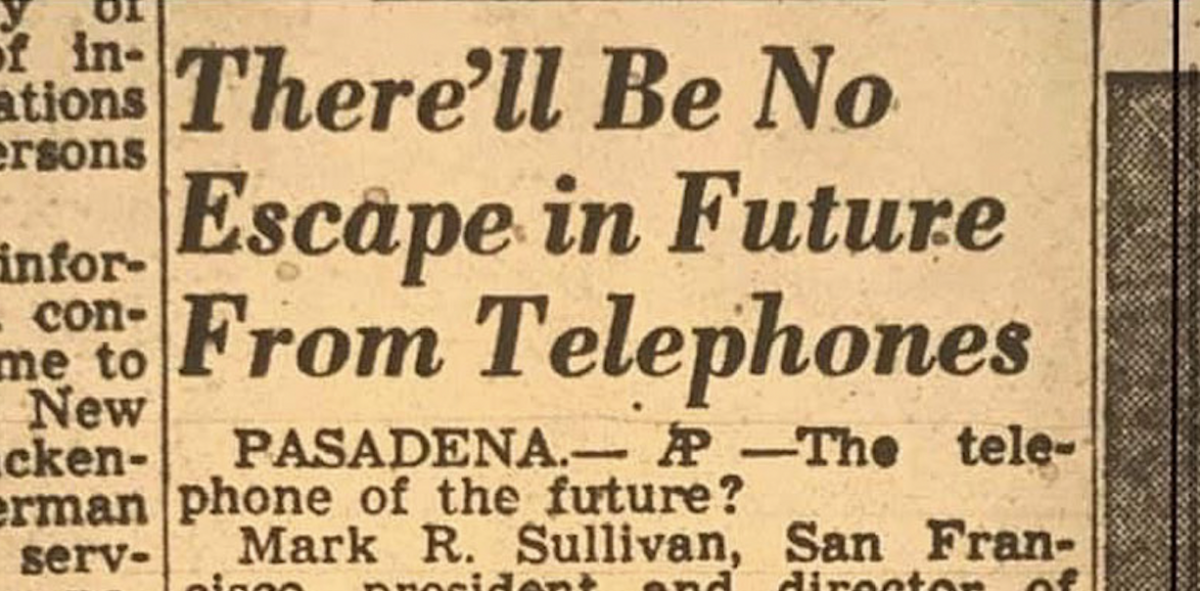
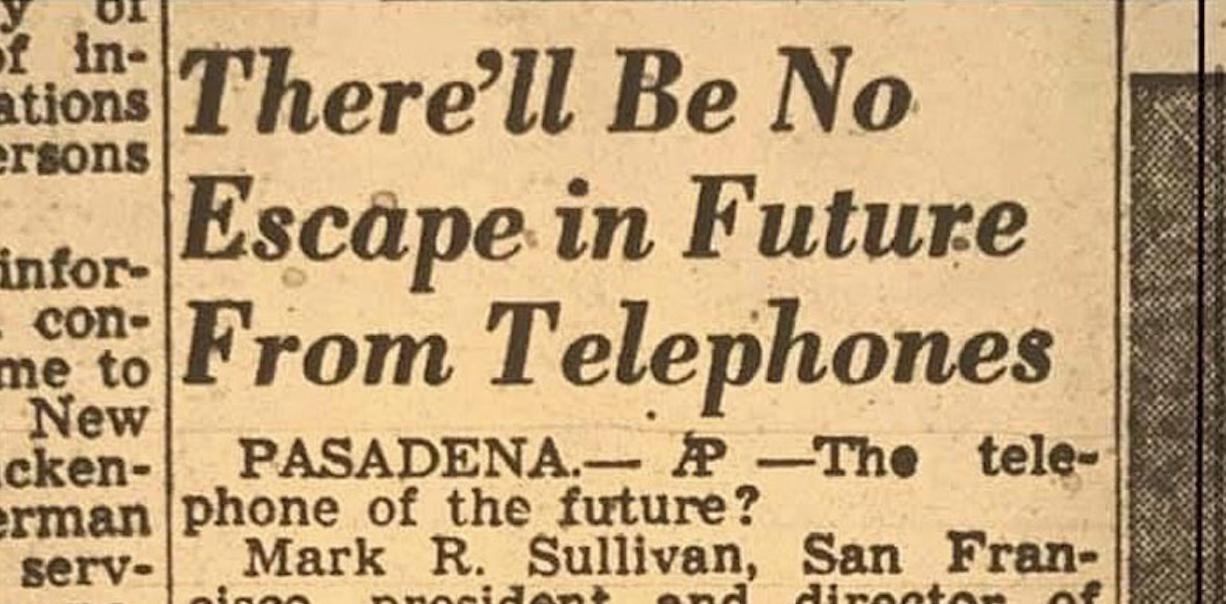
No Escape from Telephones: In 1953, a Telephone-Company Executive Predicts the Rise of Modern Smartphones and Video Calls. Given this predates a time in which regular telephones were scarce and not easily available, this is a pretty bold prediction. How right Mark R. Sullivan was.
No Escape from Telephones
We live in the age of the smartphone, which took more than a few of us by surprise. But in all human history, not a single piece of technology has actually come out of nowhere.
Customer Experience will get back customer centricity in 2022. A good way to start the year is with a fnord.
Of course one needs to ask to learn how customers feel or use a product to improve. Sometimes these needs and goals are conflicting and easy to mess up the experience.
Printer Survey
Twitter user @pikelet found this on a Canon printer.
Of course, the predictions include the metaverse. You’ll be surprised by this particular prediction, number 5 in the article. However, I wouldn’t be surprised if it was true. Chances are vague, though.
Die Automobilbranche schaut ja schon länger auf die Erfolgsstories der Softwareindustrie. Mieten statt kaufen, monatliche Einnahmen statt einmaliger Kosten. Für die Standheizung nur im Winter bezahlen zu müssen scheint dem ein- oder anderen Kunden ja auch noch nachvollziehbar zu sein. Wie der Benutzer @_uni_corn_ auf Twitter berichtet, kann es allerdings sein, dass Skoda den Ansatz überzieht.
Ich finde Skoda übertreibt das mit den kostenpflichtigen Zusatzfeatures etwas…